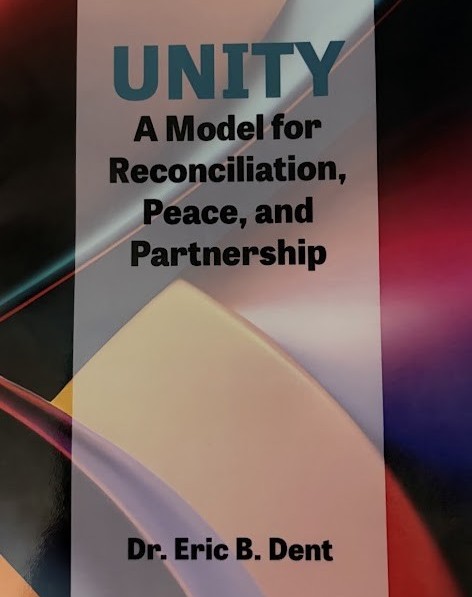
Dr. Eric Dent has written a powerful new book that documents the key factors underpinning the work of Moral Re-Armament (now Initiatives of Change) in the period between 1938 and 1965. Unity: a Model for Reconciliation, Peace, and Partnership (htps://unity-book.com/) focuses on the role this global movement played in the post-war reconciliation of France and Germany, and the rebuilding of Japan’s relations with its Asian neighbors. Dent also documents MRA’s role in improving industrial relations, particularly in the US aircraft industry; the remarkable impact on segregated Atlanta, Georgia of a musical drama, “The Crowning Experience,” starring the African American singer, Muriel Smith; and he devotes a chapter to the radical change in the life of an ambitious Australian politician, Kim Beazley, who became Minister of Education and an advocate for the indigenous people.
Den packs an impressive amount of information into just 164 pages. At the start of the book, he explores the meaning of “unity” as expressed by several scholars, and the tensions between diversity and fragmentation, and alignment and conformity. He shows how MRA’s key elements of change were present in all the activities: receiving “guidance” in times of quiet; starting change in yourself first through the application of moral standards (honesty, purity, unselfishness, love), confession and apology; and making decisions based on what is right, not who is right. The movement was inclusive, reaching beyond the divides of race and class. It relied entirely on thousands of volunteer staff; widespread use of theater and conferences with large numbers of people traveling together; and “intimacy” – the focus on homes as places of welcome.
The author calls the years from 1938 to 1965 “the heyday for MRA,” a claim that may spark healthy discussion. I began working with the movement in the late 1960s, and I remain in awe of the scale of operations in Buchman’s day, which were largely financed by individuals with resources. I have also witnessed major internal changes in the decades in the past five decades. IofC has evolved from a largely top-down organization led by Buchman and a few colleagues to a highly diverse, locally-driven movement.
Today’s teams are rooted in their communities, and they work steadily to apply the principles Dent describes to specific needs in their own part of the world. Hope in the Cities, the nationally recognized model for healing and dialogue pioneered in Richmond, Virginia, has given birth to the Trustbuilding Program, led by teams in Asia, Africa, Australia, Europe, and the Americas. It was honored as an “outstanding peace organization” with the 1926 Luxembourg Peace Prize. The global, women-led Creators of Peace initiative, launched in 1991, is active in some 40 countries. At the 35th anniversary, the keynote was delivered by Ahunna Eziakonwa, UN Under-Secretary-General and Special Advisor to Africa. She said, “Peace is something that begins in the human heart and moves outward from there, into homes, into workplace, into communities, and into nations.” Thirty-six national teams and programs now make up Initiatives of Change’s international association.
We owe a great debt to the founders who, as Dent emphasizes, demonstrated the importance of unity in building reconciliation, peace and partnership. This is a priority for today’s diverse network as it explores ways to build sustainability for a global movement that can no longer rely only on volunteers. Eric Dent’s book is a valuable resource for all those seeking an accessible and practical analysis of this unique life-changing and world-changing project that continues to evolve while remaining rooted in core principles.
Dr. Eric Dent serves as Professor and Uncommon Friends Endowed Chair in Ethics at Florida Gulf Coast University. His work is published in leading journals across a wide range of fields. He also consults with Fortune 500 companies, government agencies, and nonprofit organizations.