In a recent New York Times column, Sabrina Tavernise writes that Americans of all political stripes have lost trust in our institutions, industries and politicians. “Whether on data centers, chemicals in food, the Epstein files or the war in Iran,” she writes, people feel as if “they are being lied to.” This breakdown of trust is occurring not only in the USA but in many countries around the world. In the UK and Germany, right-wing parties are gaining ground as people feel increasingly disconnected from those in power and people with access to resources.
In the USA, Trump was swept to office by a big swing among working class voters who were “thrilled by his anti-establishment anger”, his ability to make them feel good about themselves and his promises to address bread-and-butter issues. Today, he is losing many of those voters as they face rising living costs costs and a war with Iran. Hispanics, who voted Republican in unprecedented numbers in the last election now believe they were misled. On the other side, Democrats also are challenged by the perception that they have become part of the upper-class and intellectual elite. Many blue-collar workers see the party as too focused on cultural issues rather than the glaring economic inequities.
Until a few years ago, the topic of trust rarely made the headlines. Today, you can hardly open a newspaper without finding some reference to it. Many people would agree that greatest challenges in our communities, our countries and the world are not intellectual, or technical, or even economic. They are problems of lack of trust. It is becoming increasingly evident that trust is an essential moral foundation for the functioning of democracy.
What is trust? Most of us have an implicit understanding, but its multidimensional nature makes it hard to describe although we are very aware when it is present and when it is not. Kate Monkhouse, a British trainer and facilitator, likens it to “ligaments in the body, holding things together. When crises occur, it is fit to flex and respond – or snap – if stretched.” In the course of writing a paper on the Theory of Trust (2020), I consulted several practitioners and scholars, as well as various books and research papers. Here are a few of the reflections on trust and how each of us can build or rebuild it that stand out.
Demonstrate a trustworthy quality of life. Patrick McNamara, who served as Director of International Studies at the University of Nebraska at Omaha, is now Executive Director at the United States-Sri Lanka Fulbright Commission. He highlights the intrapersonal dynamic. He says, “You cannot build trust with others if you do not trust yourself.” Marc Gopin, who directs the Center for World Religions, Diplomacy, & Conflict Resolution at George Mason University, writes in Healing the Heart of Conflict, “What goes on between people cannot be separated from what goes on inside people. Who we are, deep inside, will determine how well we get on with others, and so, if we want to fix our conflicts …we had better get started on ourselves.” Personal practices to nurture our own inner lives are essential for trustbuilders. McNamara says, “If you do not feel your life is aligned with your values and calling, it is very difficult to trust yourself.” He cites his own three-fold practice of “centering prayer, individually and with a group; openness to God’s leading through regular times of quiet; and teamwork with colleagues who know me and who can hold me accountable.”
In the UK, Louie Gardiner and her colleagues have identified “Seed Behaviors.” They state that “safeguarding my own trustworthiness calls for proactive commitment to act with integrity and to equip myself to engage compassionately, safely, and boldly in the service of that which calls me to action.” The question to ask is, “What shall I do each day for others to consider me trustworthy enough to stand alongside me?” We must walk the talk and demonstrate authenticity. People pay more attention to what we do than to what we say. Qualities such as honesty, integrity, humility, vulnerability, compassion, empathy and reliability tend to engender trust.
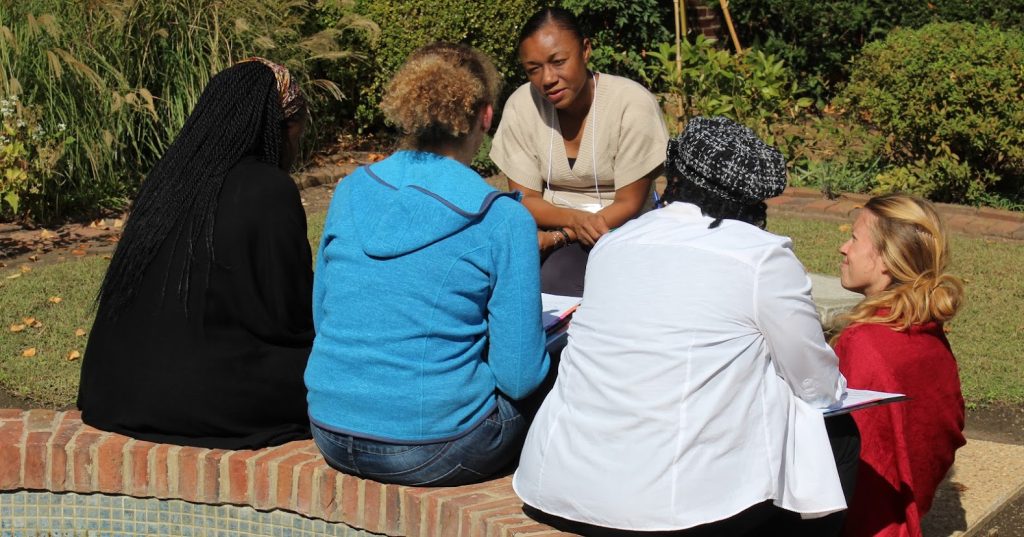
Listen to others and engage all stakeholders in honest conversation. We must learn to honor different stories and experiences, even those difficult to hear. People are more likely to accept challenging data if they feel their stories are being heard. Careful listening and speaking honestly can move us from an exchange of information to an experience of transformation. As I write in my book Trustbuilding: An Honest Conversation on Race, Reconciliation, and Responsibility, “When we experience dialogue at this level, we respond and behave differently. We relate to other people differently and choose different priorities in our lives. Our friendships, our interests and our world view are all deeply affected….Such dialogues create space where people feel able to express their deepest emotions, listen carefully, and find the courage to shine a spotlight on their own responsibility for change instead of accusing others.”
Step beyond our comfort zones. Studies show that Americans have an increasing tendency to socialize with like-minded people and to live in regions of the country which are conducive to their cultural and political outlook. We’ve grown physically and emotionally distant from one another: our hopes, fears and preoccupations. Ernest lectures do not touch the emotions. We all need to make a conscious effort to put ourselves in environments where we may hear different experiences and different concerns. We may be surprised to find some common ground.
Acknowledge historical harms. Joseph V. Montville (1937-2022) was a distinguished foreign service officer, educator, author, a committed activist in the service of peace, and the the architect of Track II diplomacy. He wrote, “When one or more sides has suffered traumatic historical or current losses whose depth and tragedy have not been acknowledged, or atoned for, wounds do not heal. Time does not heal wounds. Only healing, actively pursued, heals wounds. Consciously or unconsciously, these wounds are part of the historical identity of the losing side, handed down from generation to generation.” What is needed is honest uncovering of the past, and a reframing of the narrative that enables the consciousness of people to be “activated in the most positive sense.” (Greisdorf and Corcoran, Connecting Communities).
Recognize the difference between intent and impact. At an individual level, one might say or do something intended to be helpful, but which is heard or experienced by the other party as hurtful. In the public arena, policies may be designed and implemented with the best of intentions, but the impact may have unforeseen negative consequences on a group or community. For example, the push for” “urban renewal” a federal initiative that cleared areas deemed “blighted,” aiming to modernize infrastructure and stimulate growth, often forced hundreds of thousands of families and individuals out of their homes, disproportionately uprooting African American neighborhoods and minority communities. At both the individual and the public level injured parties may experience loss of confidence in the trustworthiness of the other party.
Honor everyone’s dignity. Barry Hart, a professor emeritus at the Center for Justice and Peacebuilding at Eastern Mennonite University where he focused on conflict, integrity and conflict studies, writes that in conflict situations, as negotiators recognize their own value and worth, they begin to be open to the possibility of the same in others. “It is this dignity nexus of value and worth within members of the negotiating parties that provides a sense of common humanity and purpose and allows for the possibility of meaningful and workable agreements to emerge. Not that this is an easy process or even possible in all cases, but when a bridge between parties is built on the premise of one’s own and the other’s worthiness and value, there is a greater potential for transformational thinking and acting to take place.”
Build trust within a group as well as between groups. Joshua Ballew, a practitioner, notes that in large-scale conflict or tensions, interventions typically occur among only a portion of each group. As trust is built between individuals of two groups, there is a risk of a reduction in trust between groups. He likens the task to moving stones up a mountain, where the stones correspond to the complexity of the issue. Therefore, we must constantly monitor progress. “Once we identify which stones must be taken up the mountain, and check that both the mountain of the other and one’s own group are being climbed, then those stones that reach the top can be assembled into a bridge of trust between groups.”
Commit to action. Melvin Dowd, a clinical psychologist, educator and biomedical ethicist, says, “To sustain trust there must be committed action among all parties. We make promises to each other and then hold each other accountable to the promises we made.” It is this step that connects change within and between individuals to the possibility of transformative change in society.
Build a team. Building trust in a community and between communities is hard work and people of many social backgrounds with different skills, experiences and perspectives are needed. Bringing such teams and partners together will inevitably produce tensions that must be faced honestly. Teambuilding is often the most neglected aspect of social change efforts. As my colleague, the late Rev. Sylvester Turner often reminded us, movements don’t fail from the outside, they fail from the inside. But with persistence and vision, it is possible to create what the educational innovator, activist and reformer John Gardner describes as “networks of responsibility drawn from all segments coming together to create a wholeness that incorporates diversity.” (Peirce and Johnson, Boundary Crossers)
As someone who has spent decades working to bridge deep community divides, I find these reflections extremely helpful. They are a reminder of things that we can all do to build the trust that is the foundation for just, peaceful and inclusive societies.