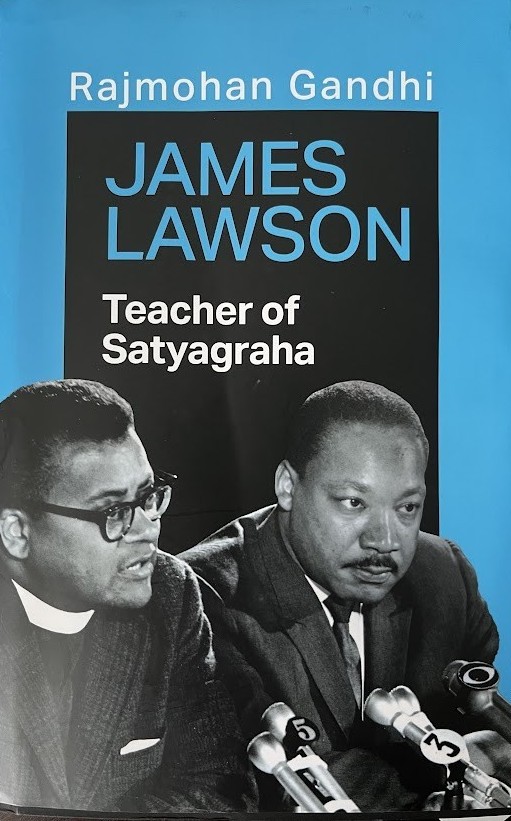
Rajmohan Gandhi’s new book, James Lawson, Teacher of Satyagraha, carries important truths for today’s America. At a time of intense polarization and assault on civil rights, those fighting for justice need a moral compass. Lawson demonstrated that love is more powerful than condemnation. He was to become the primary teacher of satyagraha (holding fast to the truth) nonviolent resistance.
James Lawson (1928-2024) grew up in Ohio. The son of an African Methodist Episcopalian minister, he felt drawn to ministry at an early age. Before entering college, he was licensed by the Methodist church as a local preacher. He became deeply interested in Mahatma Gandhi’s work in India and felt convinced that he would be part of a nonviolent movement in the U.S. He refused to submit a draft form, and experienced several months in a tough prison environment where he was forced to confront in his own spirit the cost of nonviolence and his readiness to experience suffering.
On graduation, he was assigned by the Methodist Church to a college in Nagpur, India, where he supported the students’ moral and spiritual life and trained their sports teams. Lawson was never interested in missionary work. “I had formed the view that a person, every person…is gifted with autonomy and personal accountability for that gift… That the paths toward truth and God are manifold, very much more than one or two.”
Rajmohan Gandhi is the grandson of the Mahatma and has written several definitive books on him. He notes that the three years in India were pivotal in Lawson’s life. He devoured all the material on Gandhi that he could lay his hands on. He was riveted by an account of a three-hour conversation in 1936 between Gandhi and a group of Black Americans led by Howard Thurman, the philosopher, author and civil rights educator. In that conversation Gandhi stated his belief that Americans would lead the world in nonviolence. Lawson was to say later that Gandhi was absolutely correct. “You can’t overcome evil with evil. Wrong has to be changed into that which is right. Gandhi brought into the mainstream of history the truth that violence cannot heal or build a city or construct a better nation.”
His three years in India coincided with the Supreme Court’s Brown v Board of Education judgement ruling that racial segregation in public schools was unconstitutional, and the boycott of Montgomery’s bus company after Rosa Parks was arrested for refusing to give up her seat to a white passenger. This gave impetus to Lawson’s conviction to base in the South. While studying at Oberlin College, he met Martin Luther King, Jr. who was a guest speaker. The two were the same age and bonded instantly. King saw Lawson not only as a kindred soul with a shared dream but “also one who might bring to the movement the understanding that was needed.”
From Ohio to Tennessee
In 1958 Lawson headed to Nashville, Tennessee to attend divinity school at Vanderbilt University. Nashville was just taking the first steps towards integration and Lawson was only the second Black to be admitted to the divinity school. Rev Kelly Smith, pastor of First Baptist Church and chairman of Nashville Christian Leadership Council, invited him to present nonviolence at an NCLC gathering. He led his first satyagraha classes in the basement of a church near Fisk University and American Baptist Seminary. One regular attendee from the seminary was the future congressman John Lewis who later wrote in his autobiography, “Those workshops became the focus of my life, more important even than my classes.” Other future leaders of the movement who attended the workshops included Bernard Lafayette, James Bevel and Diane Nash. Some of the regular participants described themselves as Lawson’s “mentees.” In Nashville, Lawson met Dorothy Wood, a civil rights activist in her own right, who was to become his wife and lifelong partner in the struggle. Together they raised three children.
The Nashville Student Movement, as it was known, began to organize satyagraha in a campaign to desegregate restaurants and downtown drugstore lunch counters. It was the first effort in the South to desegregate drugstore eating facilities. The resulting publicity prompted a rush of new recruits. Several large-scale sit-ins took place. They were highly organized and disciplined, having been rehearsed according to Lawson’s instructions.
Before one large sit-in, the mayor decided to withdraw the police, leaving thugs free to assault sit-in students. Then the police would move in and arrest the students. Despite beatings, students followed guidelines for nonviolence that were widely distributed. The final points were, “Remember the teachings of Jesus Christ, Mahatma Gandhi and Martin Luther King. Love and nonviolence is the way.” John Lewis later wrote about the trip in the paddy wagon to jail that it “seemed like a chariot to me, a freedom vehicle carrying me across the threshold…When we got to the city jail, the place was awash in jubilation.” The Tennessean reported that the previous day Lawson had told an overflow crowd at a church in Chattanooga, that the sit-ins were not “to stir up trouble, but to make both Negros and whites take a good look at ourselves.”
Lawson’s approach was impacting desegregation efforts in other cities. He was asked to address a conference at Shaw University in Raleigh, NC. This conference saw the launch of the Student Nonviolent Coordinating Committee (SNCC) and it was said that the Nashville group brought “the knowledge and experience …that helped shape the culture and tactics of SNCC from the very beginning.” The SNCC statement of purpose affirmed, “By appealing to the conscience…nonviolence nurtures the atmosphere in which justice and reconciliation become actual possibilities.” By 1960, the lunch counters in Nashville were integrated and satyagraha had taken place in 110 southern cities. That same year, James Lawson was expelled from Vanderbilt for leading the sit-ins. In 1961, the Congress of Racial Equality (CORE) which had been working for racial equality in the north for decades, organized the first “Freedom Rides” to bus terminals in the Deep South. The following year, Lawson was appointed to lead Centenary Church in Memphis, the largest Black Methodist Church in the Mid-South. When Martin Luther King, Jr. came to give support to the sit-ins, he told an audience, “I come to Nashville not to bring inspiration but to gain inspiration from the great movement that has taken place in this community.”
A sustained and disciplined effort
But as Gandhi writes, the movement for nonviolence that Rev. Lawson had shouldered encountered the headwinds of entrenched racism and the Vietnam War. Perhaps even more challenging for him was the relationship with a rising young leader, Stokely Carmichael, who pushed for a much more confrontational approach, demanding “Black Power.” Some of those resisting change suggested the demonstrations were communist inspired. These were difficult times for Lawson who always gave the impression of “cool assurance,” yet battled internal doubts. The “unflappable Lawson” was the result of “a sustained and disciplined effort on his part.”
In May 1963 the country was horrified to see the use of police dogs and fire hoses on demonstrators in Birmingham, Alabama. The activist Medgar Evers was assassinated in the driveway of home in Jackson, Mississippi. The March on Washington on August 28 brought a huge crowd who were electrified by King’s “I have a Dream” speech. John Lewis was among the other speakers. But, although he was a core strategist, Lawson stayed behind to continue the work on the ground. In November of that year, President Kennedy was assassinated in Dallas. On assuming office, President Johnson secured votes to pass the Civil Rights Act in 1964. In March the following year, the brutal attacks on John Lewis and others as they attempted to cross Edmund Pettus Bridge in Selma, Alabama, gave impetus to the passage of the Voting Rights Act. Gandhi writes, “The strategy of obtaining change by exposing through nonviolent direct action, the ugliness and unconstitutionality of racial discrimination had worked. Lawson had championed this strategy with clarity and persistence.”
In 1965 James Lawson went on a peace-seeking mission to Vietnam on behalf of King and the Southern Christian Leadership Conference. His visit “may have contributed to King finally and dramatically taking a public position” against America’s war there. Economic issues were also coming to the fore, highlighted by the strike of sanitation workers in Memphis with the slogan “I AM A MAN.” The white establishment was furious, and Dorothy Lawson fielded daily calls threatening her husband. Meanwhile, young Black Power activists viewed Lawson, who was barely 40 years old, as too old and too conservative. It was not clear whether the protesters were ready to take part in a nonviolent struggle. “In Nashville, nonviolent resisters had received months of training. In Memphis there was no time for it.”
Memphis tragedy
King came to Memphis at Lawson’s request. A march drew a large group which was orderly until protesters at the back of the march broke off and began smashing windows and looting stores. Police shot a black youth and martial law was declared. More than 3,800 National Guardsmen moved into the city. Gandhi writes, “it was perhaps the worst day in Lawson’s life.”
A week later, on April 3, King was back in Memphis, joined by Andrew Young and Ralph Abernathy. Lawson and the Committee on the Move to Equality (COME) which he co-founded, had organized a meeting at the Mason Temple that night. King was tired and reluctant to attend, but immense numbers had gathered and Abernathy persuaded him: “Just show up and say hello.” When he rose to speak, King told the rally that Lawson was “the leading theorist and strategist of nonviolence in the world.” This was the moment when he gave the immortal “I’ve been to the mountaintop” speech. The next day the team relaxed, and Lawson drove home “to keep to his rule of a 6 p.m. family dinner.” As King stood on the motel’s balcony, he was struck and killed by a bullet fired by a sniper.
Overcome with grief, Lawson immediately recorded a message calling for calm and prayer. That night, together with Benjamin Hooks, the only African American judge on the criminal court of the county to which Memphis belonged, he toured the city repeating the call for nonviolence. Another march to honor’s King’s spirit was organized. Lawson told the crowd in front of City Hall that there would be no more violence in the city’s black neighborhoods, but “if this curfew, which is for black people only does not end, we’re going to end it.” Bayard Rustin was to say that the people of Memphis had given “Dr King what he came here for and what was his last wish: a truly nonviolent march.” A few days later, thanks to an intervention by President Johnson’s Under Secretary of Labor James Reynolds, the sanitation workers’ strike ended on terms close to what they had demanded.
Satyagraha with the labor movement
The final part of Gandhi’s book briefly describes the surprising move of Rev. Lawson and family to California in 1974, at the request of Bishop Charles Golden, to serve as pastor of Holman Methodist Church in Los Angeles. As Gandhi notes with some astonishment, “James and Dorothy would spend fifty years in Los Angeles…more than three times his sixteen years in the South.” Even more surprising is the fact that he agreed to conduct the marriage of the man who killed King, James Earl Ray and his fiancée Ann, in 1978, twenty years before Ray died in prison.
In California, Lawson became increasingly involved with the labor movement. Labor leaders received training similar to what what had been given in Nashville in what became known as the “Holman Group.” Two were to become mayors of Los Angeles. In 1989, Maria Elena Durazo, president of Local 11 of the Hotel Employees and Restaurant Employees Union which was fighting for fair working conditions from Hyatt-owned hotels, approached Lawson for help. With his advice, conversations took place in employees’ homes; workers became organizers, and built a sense of community. Gandhi notes that “thirty years after they had been conducted in Nashville, role-playing rehearsals were repeated in Los Angeles.” Lawson and Durazo were frequently detained. The satyagraha method was again used in an eight-year struggle for fair practices with the University of Southern California. Lawson also organized pastors as Clergy and Laity United for Economic Justice. From 2002, he began regular teaching at UCLA . And, in a change of heart in 2006, Vanderbilt made him a Distinguished University Professor. For many at Vanderbilt and UCLA he was “a legendary figure.” Lawson continued public speaking into his nineties. In 2021, the UCLA Labor Center in MacArthur Park was renamed the “UCLA James Lawson Jr Worker Justice Center.
“You cannot overcome evil by following it”
Rajmohan Gandhi recalls that as a young man volunteering with Moral Re-Armament (now Initiatives of Change) in 1957, he met Martin Luther King, Jr. in Washington, DC. and also his father in Atlanta. He met James Lawson for the first time in 2019 in California, but COVID prevented future meetings. However, they participated together in online conferences and forums. And towards the end of Lawson’s life they had some extended phone calls. Lawson reiterated his belief that “you cannot overcome evil by following it. You cannot use the tactics or the structure of the wrong to correct it.” You have to figure out “how you in your own life will represent…the non-evil, the good, the just, how you personally will use your life, to represent the things that make for life.”
James Lawson was not a great orator like his colleague Martin Luther King, Jr. But Gandhi portrays him as someone who gave detailed attention to preparing individuals with the principles and tools of nonviolence, and who was “accessible and loved” as a pastor. Marian Wright Edelman describes him as “a peerless teacher.” He maintained a disciplined life (home for family dinner every night) and he kept strong in his faith and in steadfast obedience to what he knew to be right. May we learn from his example.
(c) Rob Corcoran robcorcoran.org
James Lawson, Teacher of Satyagraha, published 2026 by Speaking Tiger Books.
For a paperback copy go to Speaking Tiger Books For hardback go to Amazon